
Vesperine research desk
No content-farm horoscopes. Each piece needs method, sources, counter-signals, and a visible review trail; practitioners can contribute guest notes to the public research record.
Published essays
Born in Canada Near Lunar New Year? Your Zodiac Animal Might Not Be What the Family Says
Every Chinese-Canadian family has a version of this argument: grandma insists the kid is a Rabbit, an app says Dragon, and nobody can explain why they disagree. For births within a few weeks of Lunar New Year, the answer usually comes down to two things — which year boundary the speaker is using (festival day one vs the Li Chun solar term), and the fact that a birth in Toronto or Vancouver happens hours behind the Asian clocks most calendars are compiled on. This article shows how the year boundary actually works, how to convert a Canadian birth against it yourself, and why the answer matters for any chart-based reading — no middleman required.
The Red Almanac in Your Parents' Kitchen: A Canadian Guide to the Tong Sheng
Many Chinese-Canadian households own one: a thick red-bound almanac that appears near the lunar new year, consulted for wedding dates and renovation starts, then quietly retired to a drawer. This article explains what the Tong Sheng (通勝/通書) actually contains, how its daily suitable-and-avoid listings are generated, what breaks and what survives when you use it from a Toronto or Vancouver time zone, and how to keep the family habit alive as the generation who could read it fluently gets older — without needing a middleman for every question.
The Chart Your Grandmother Had Cast: A Continuity Guide for Chinese-Canadian Readers
Many Chinese-Canadian families carry a half-remembered tradition: a grandparent had charts cast for weddings, business openings, or a newborn's name. A generation or two later, the language is gone but the curiosity remains. This guide maps what that tradition actually was — BaZi, zi wei dou shu, date selection — what survives translation into English, what gets lost, and how to explore your own chart without pretending the family knowledge gap doesn't exist.
Before You Buy a Reading: Turning a Vague Worry into a Question BaZi Can Actually Address
Most disappointing readings fail before they begin — the question was never askable. This guide shows how to turn a fog like 'should I quit my job?' into a question with a subject, a time window, and an observable outcome; what a BaZi report can and cannot answer; and how to evaluate the reading you get.
How to Use Oracle: Let AI Organize the Details, Then Bring the Deeper Questions to a Human Teacher
A practical usage guide and platform ethics statement for Oracle. Start with one real question, use Tarot to surface the first signal, use BaZi, Zi Wei, the I Ching, Qi Men, and Six-System Oracle Reading to examine structure and change, then bring the report to a human teacher when the question needs deeper judgment, life context, and compassion.
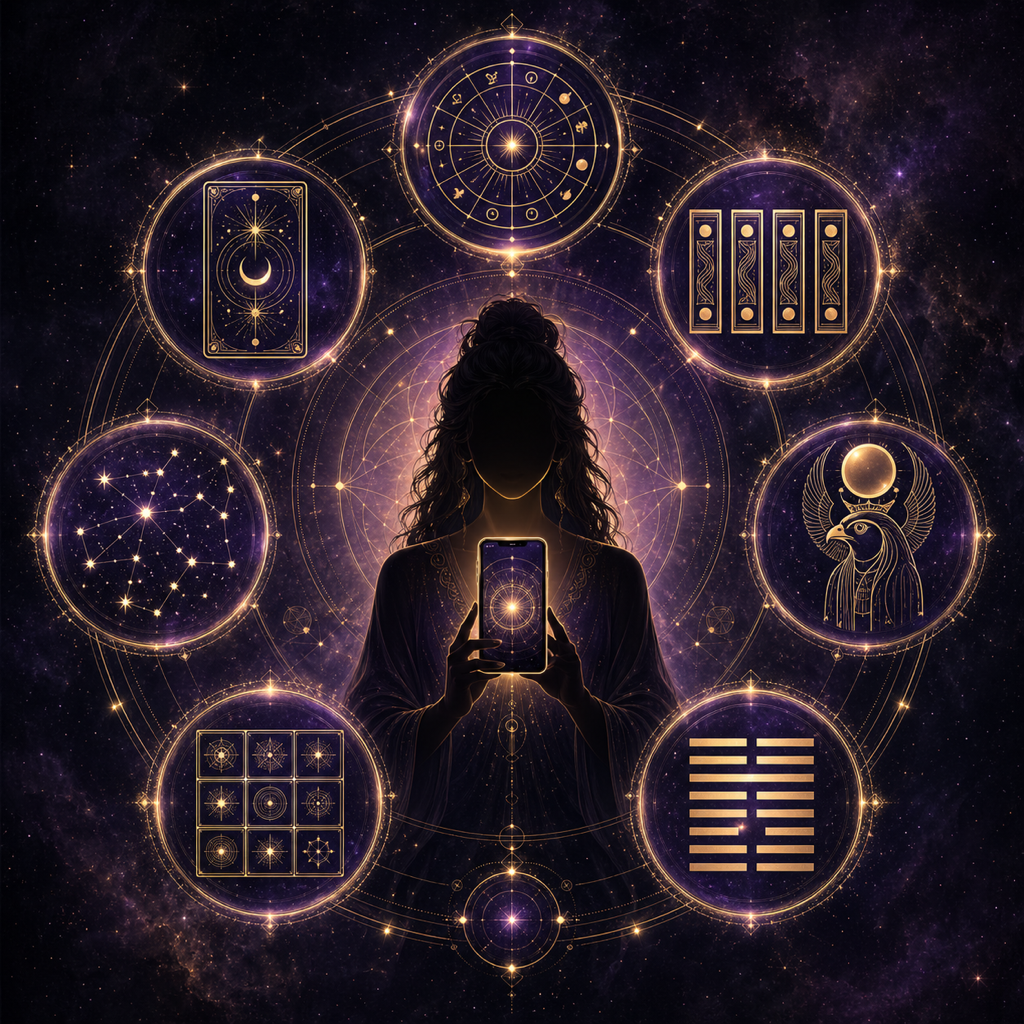
Why I Created Oracle: When Ancient Divination Meets High-Dimensional AI
A founder letter on why Oracle begins with a card, opens into a chart, and then cross-checks one real question through Tarot, BaZi, Zi Wei Dou Shu, Qi Men Dun Jia, the I Ching, and the Egyptian Oracle. Oracle is not built to turn destiny into a verdict. It is built to make complex life signals visible, comparable, and actionable.
Why Oracle Doesn't Let You Re-Roll: The Design Philosophy Behind Drawing Blind
Most modern tarot apps quietly compromise their own readings by letting users re-shuffle, swipe-to-pick, or 'feel which card calls them.' That's not a reading; it's a mood board. This essay explains why the architecture of drawing blind exists, where it comes from in the classical literature, and what it changes about the moment between asking and knowing.