

What this piece argues
Most modern tarot, astrology, and oracle apps quietly compromise the integrity of their own readings by giving you control over the result. Endless shuffles, swipe-to-pick, "tap the card that calls you" — all of these are subtle invitations to shop until you find the answer that flatters your existing position. A reading that bends to your preference is, by definition, no longer a reading. It's a mood board.
We built Oracle around the opposite assumption. Every reading begins face-down. The card you draw is the card you get. The chart you were born under is the chart you read. We don't let you re-roll, and that's not a flaw — it's the whole point of divination.
This piece explains why that constraint exists, where it comes from in the classical literature, and what it changes about how you receive an answer.
The architecture of drawing blind
The classical divination systems — the I Ching, tarot, Bazi (Chinese Four Pillars), Ziwei Doushu — share a structural commitment that most modern UI doesn't:
You name your question. You commit. *Then* you receive what arrives.
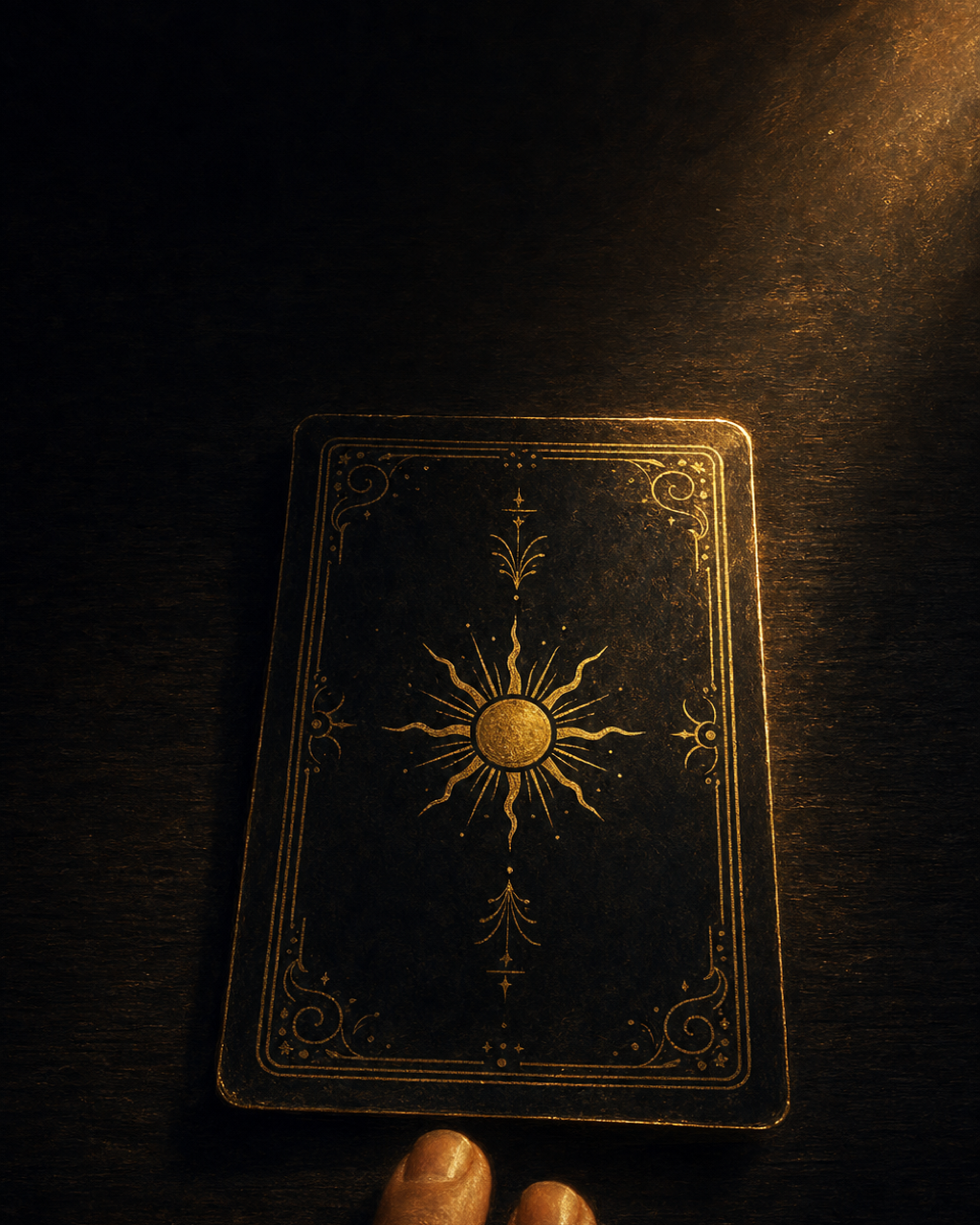
In the I Ching, you toss three coins six times to build a hexagram. The classical alternative — yarrow stalks — takes longer but achieves the same end: a result outside your conscious choice. In Tarot, the deck is shuffled and the top cards drawn face-down, in order. In Bazi, the chart is fixed at the moment of your birth — you cannot negotiate it backwards. Each system is designed so that between asking and knowing, you don't get to peek.
This is not a quirk of pre-modern technology. It is the engineering of honest reflection. Carl Jung, in his 1949 foreword to the Wilhelm-Baynes I Ching, articulated it through the principle of synchronicity: meaning emerges in the *coincidence* between an honest question and an unbiased answer. Strip the unbiased part, and you have nothing — just a self-selected story.
Why most divination apps fail this test
Open the App Store and look at the top tarot apps. The pattern is identical:
- Endless re-shuffles ("don't like the spread? swipe again")
- Swipe-to-pick ("choose the card that calls you")
- Vibe-based decks ("today's energy says…")
Each of these is a UI decision that maximises engagement metrics and minimises the actual work of divination. They optimise for "user satisfaction" with the result, which by construction means: optimise for confirmation bias.
A user who can re-roll until they like the answer never gets a real reading. They get a search result for the answer they were already looking for. The app *feels* good — they leave smiling — but no information has actually moved between the unconscious and the conscious. The architecture doesn't allow it.
This is not a moral judgement on those designers. It is a description of what their incentive structure produces. When user retention is the optimisation target, friction-removal beats integrity-preservation every time.
What changes when you can't re-roll
The interesting work happens in the gap between *I asked* and *I'll know*. That gap is where you discover what you were actually hoping for — what you'd already decided, what you were afraid of, where you'd taken a position you hadn't admitted.
A blind draw forces that recognition because you can't bargain with the result. The card is the card. The hexagram is the hexagram. Your job stops being "select the right answer" and becomes "interpret what arrived." That interpretation is where the reflection actually happens — and it's the part most apps remove by letting you keep drawing until the meaning is convenient.

This is also why, at Oracle, we don't generate a new reading body if you don't like the first one. The patient-retry mechanism in our LLM pipeline retries on *quality* failures (model bailout, leaked scratch-work, language-mismatch) — not on user dissatisfaction. If the result reads as "not what I wanted," that's information about you, not a defect in the system.
Caveats and limits
This essay isn't a claim that divination predicts events. It claims something narrower: the *ritual structure* of unbiased drawing is what makes a reading honest, and removing it produces something that looks like a reading but isn't.
Oracle's readings, like all responsible divination, are tools for reflection. They do not replace medical, legal, financial, or therapeutic judgement. We say this directly in every reading and we mean it: this is for thinking, not for deciding.
If a reading suggests urgent action — quit the job, leave the relationship, make the trade — sit with it before acting. The reading's job is to surface what you already knew but hadn't articulated. The action is yours.
Source trace ledger
- Wilhelm, Richard & Baynes, Cary F. (1950). *The I Ching or Book of Changes*. Princeton University Press / Bollingen. Foreword by C. G. Jung. Used here for: the synchronicity argument; the cultural lineage of yarrow-stalk and three-coin methods.
- Pollack, Rachel (1980). *Seventy-Eight Degrees of Wisdom: A Book of Tarot*. Aquarian Press. Used here for: structural commitment to face-down drawing in modern Tarot practice and position-based reading.
- Liu Da, trans. (1971). *I Ching: The Tao of Organization*. Routledge & Kegan Paul. Used here for: classical commentary structure of Judgement (彖辭), Image (象辭), Line (爻辭) layers.
- Oracle editorial decision record: Oracle uses face-down drawing rather than repeated re-rolling so the reading starts from the first result, not from a preferred answer.
Practitioner-depth gate
What a practitioner might challenge: "Drawing blind doesn't matter if the user secretly chooses how to interpret the result. Confirmation bias just shifts from selecting the card to selecting the meaning."
Response: this is a real risk and it's why classical readings include *layered* commentary that constrains interpretation. The I Ching has Judgement, Image, and Line readings; a tarot spread has position-defined meanings (Past / Present / Future, or Situation / Obstacle / Advice); Bazi has a strict order — Day Master strength, then Ten Gods relationships, then Major Luck (大運) interaction. The structure resists confirmation bias even when the reader wants it, because reinterpreting the result wholesale would mean contradicting the text itself.
This essay does not advise on specific divination practice; it argues a design principle. No claim is made here about the accuracy or efficacy of any particular tradition. Practitioners are encouraged to disagree with the framing and to argue from their own classical training.
— *Oracle Editorial, 2026-05-09*