
Older than any zodiac, and asks the opposite question
The I Ching, or Book of Changes (易經), is one of the oldest continuously-used divination texts in any civilisation. Compiled in its current form roughly three thousand years ago in Bronze Age China and read seriously by every major Chinese philosopher since, it pre-dates Western astrology, tarot, and most spiritual systems modern readers know. Carl Jung wrote a long foreword to one of its English translations; quantum physicists and crypto traders have both quoted it.
Yet most modern divination tools share a structure the I Ching doesn't. Astrology says 'this is who you are because of when you were born.' Tarot says 'draw a card and meet an archetype.' The I Ching does neither. It asks you to name a specific question — usually a decision you're sitting with — and then casts a hexagram by deliberate chance. The hexagram is not about you. It's about the shape of the situation you asked about, in this moment. The I Ching is a method for reading dynamics, not destiny.
How a hexagram is built — the architecture of unknowing
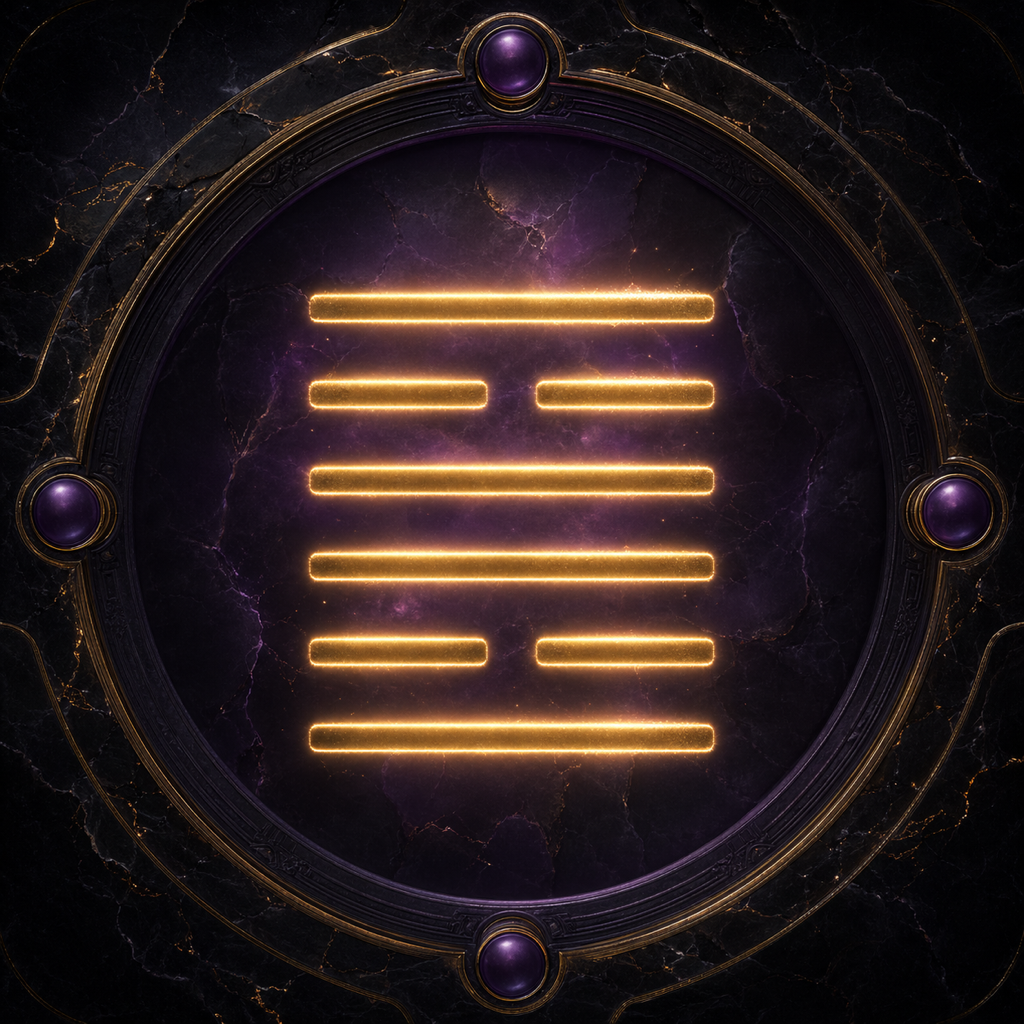
A hexagram is six lines stacked vertically, each line either solid (yang) or broken (yin). With six lines you get 2^6 = 64 possible patterns — the same sixty-four you'll see referenced anywhere a serious thinker has touched the I Ching.
Traditionally, a hexagram is generated by tossing three coins six times, or counting yarrow stalks through a more elaborate ritual. The result is unbiased: the line you get is the line you get. You can't pick. You can't shop for a better one. The point of the ritual isn't superstition — it's removing your conscious control over the outcome so the answer can be honest. This is the same architecture every honest divination uses: the I Ching coins, a tarot shuffle, the moment you were born for Bazi. You commit to the question first. Then the result comes from somewhere your bias cannot reach.
Reading what you got: judgement, image, and changing lines
Each hexagram has three layers of classical commentary. The Judgement (彖辭) is a one-paragraph reading of the whole situation: what kind of moment this is, whether it favours action or patience, what virtue is being tested. The Image (象辭) is a metaphor from nature — wind under a mountain, fire over water, thunder above heaven — meant to lodge in memory rather than be decoded literally. The Line readings (爻辭) are six short verses, one per position, elaborating how each line of the hexagram speaks to the unfolding of the situation.
If your toss produced any changing lines (lines that flip from yang to yin or vice versa), there's also a second hexagram that shows where the situation is heading. Present plus trajectory — that's the actual answer. Reading the I Ching is not pattern-matching the Judgement to your question. It's asking yourself: given the kind of moment this is, what changes about how I see my situation? The text doesn't tell you what to do. It changes the lens you're looking through. That, more often than not, is what you needed.