
The eight trigrams are the core vocabulary
Qian, Kun, Zhen, Xun, Kan, Li, Gen, and Dui carry images such as heaven, earth, thunder, wind, water, fire, mountain, and lake. They describe modes of force, not merely objects in nature.
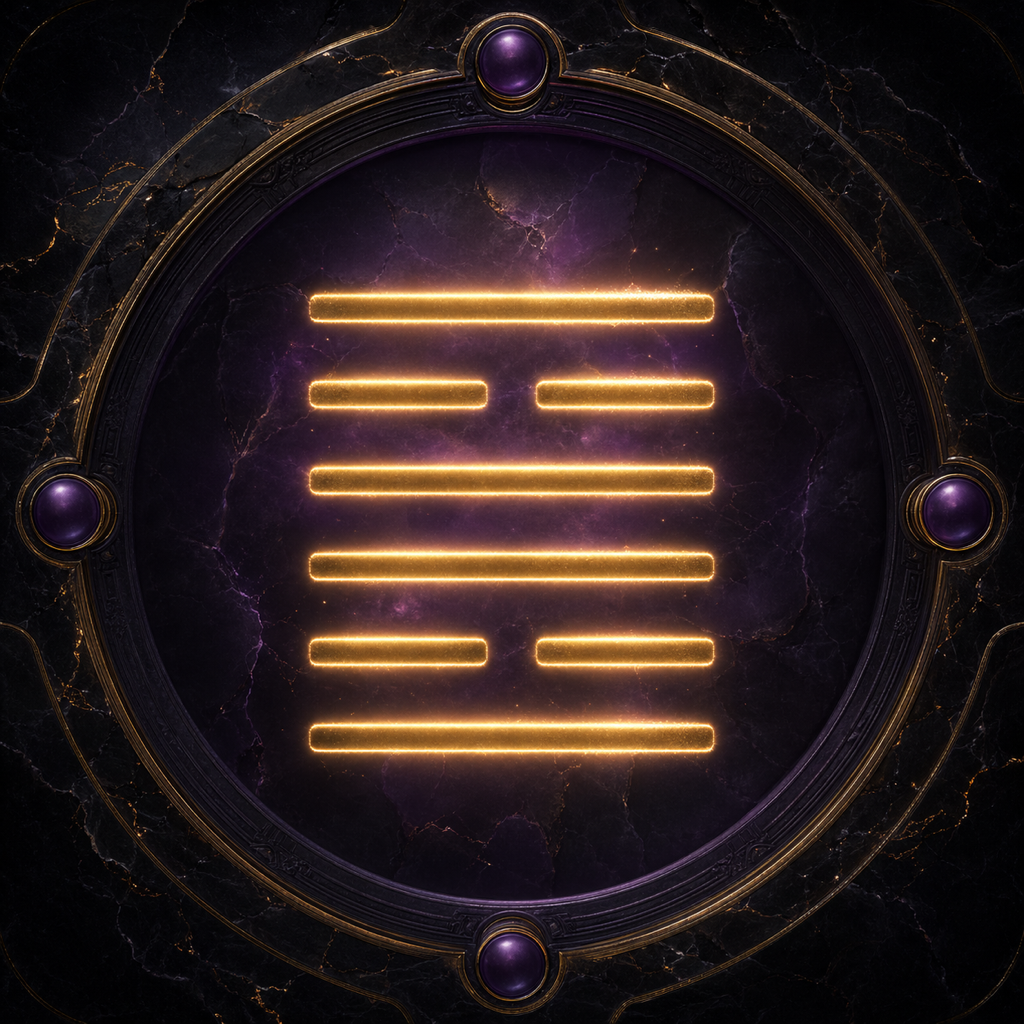
Each trigram has three lines. A full hexagram stacks two trigrams into six lines. The upper trigram often describes the outer condition, visible pressure, or larger environment; the lower trigram often describes the inner base, starting point, or hidden movement.
A hexagram is a situation, not a label
Beginners often memorise a few names: Qian is strong, Kun is receptive, Tai is smooth, Pi is blocked. That can help orientation, but it quickly becomes too flat.
Each hexagram is a structure: what force is above, what force is below, and whether the two support, restrain, mirror, or pull against each other. The name is only the doorway into the situation.
Read the interaction before judging
Before asking whether the hexagram is good or bad, ask what the outer world is doing, what the inner base can hold, and whether the two are aligned. That turns the image into a practical diagnostic.
Oracle readings avoid stopping at the hexagram name. For work, relationships, collaboration, relocation, or startup decisions, the useful thing is the shape of the situation, not a decorative label.